The burn
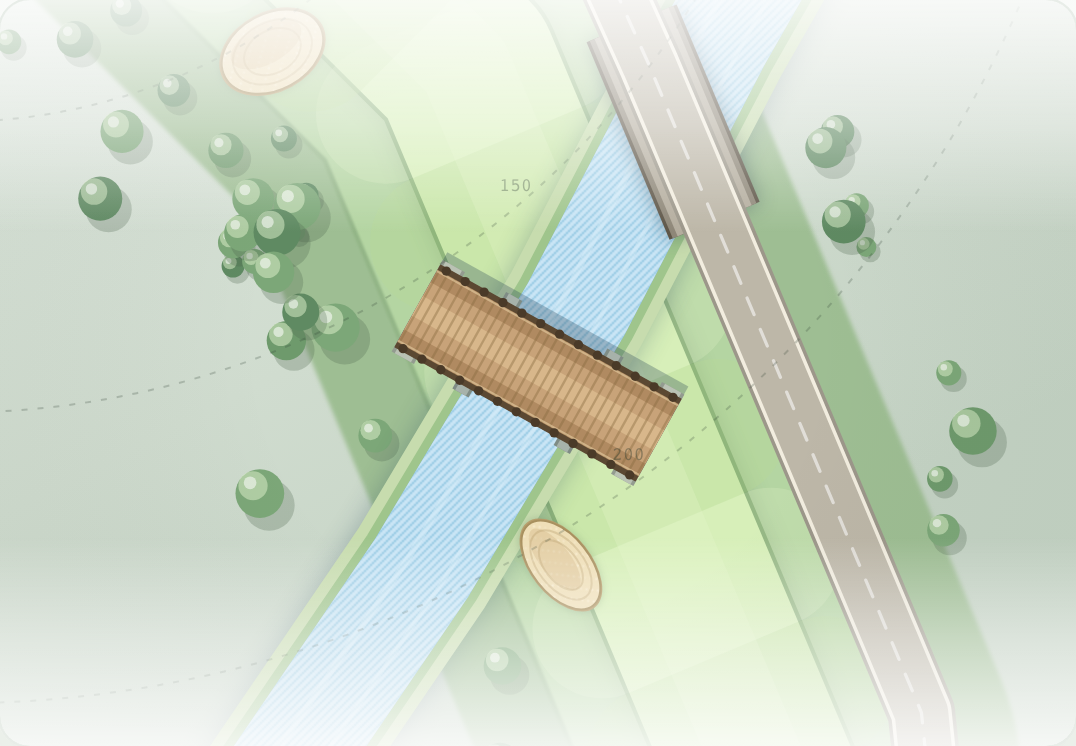
A river cut across the fairway on the diagonal. The diagonal is the whole point: it turns one decision into a sliding scale, and it is the only hazard in the game that rewards you for aiming at the trouble.
Why the angle matters
A lake asks one question: carry it, or lay up short. You answer once and the hole is over. Angling the water makes the same question continuous. Down one side the burn is a short carry that leaves you out to the side and a long way from the green. Down the other it is a much longer carry that leaves you well up the hole. Every line between the two is priced somewhere in between, and you choose your price on the tee.
That is the shot worth learning. Most players take the short corner for two or three rounds, then notice they are hitting the same second shot every time from a hundred yards further back than the people above them on the board.
The bridge
Half of all burns carry a bridge, set near the middle where it is genuinely in play. It is a gamble, not a shortcut. The deck rolls harder than anything else in the game — a ball that lands on it keeps going across to the far bank instead of drowning, so you can cross with far less club than the carry asks for. Miss it by a couple of yards and you are wet.
The cart path always crosses the burn on a deck of its own, whether or not there is a bridge. That deck is narrow and it is not a bailout — it is there because a path that stopped at a river would be a strange path.
What it costs
The burn is water. Finding it costs a stroke and a drop, and a ball that lands short and runs on finds it exactly as surely as one that never got there — which catches people out, because a pured strike that pitches two yards short still ends up in the river. The tag in the corner of the screen tells you how far out the water lies.
How to play it
- Look at where the burn meets the far rough on each side before you aim. The gap between those two points is the whole decision.
- Take the long carry when you are already timing the meter well that round. It is the line that shortens the hole, and the burn is one of the few places where being brave pays.
- If the bridge is there and you are short of club, aim at the deck rather than past it. A kick across is worth more than a heroic carry you are not going to make.
- Laying up is fine. Leave yourself on the fat side and take the extra shot — a five with no drop beats a six with one.
Where you will meet it
Burns appear only on par 4s and longer, on holes of at least 330 yards, and never more than one to a hole.