The gust
A band of fast-moving air across the hole. It is the only hazard you can fly over the top of, and the only one you can walk underneath.
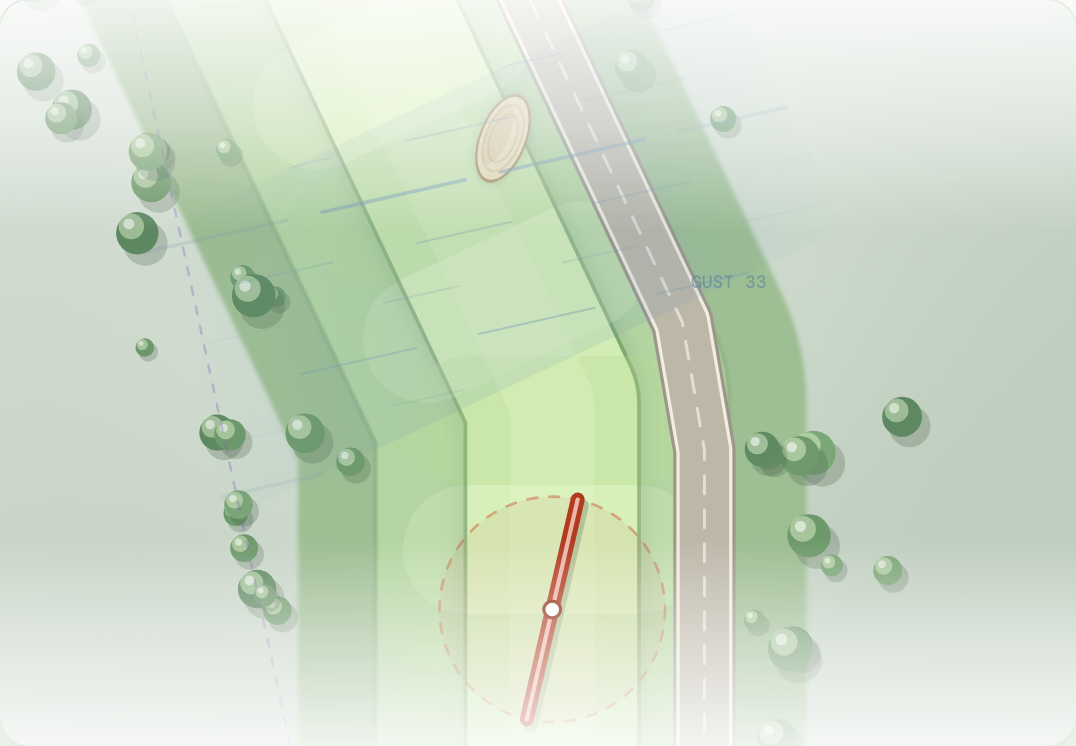
It only acts on flight
The gust is not weather, it is a place. Only a ball whose flight path crosses the band gets pushed, which means there are two ways to beat it and neither involves aiming off.
You can fly over the top of it — a full carry that lands beyond the band never enters it. Or you can lay up short and walk under it on your next shot, playing from in front of the band so your ball starts on the far side of the problem.
Why aiming off is the trap
The instinct is to aim into the wind and let it bring the ball back. That works on a real golf course, where the wind acts on the whole flight. Here it acts on a slice of it, so how far your ball gets pushed depends on how long it spends inside the band — which depends on how hard you hit it, which is exactly the thing you are least certain about.
Aiming off turns a distance problem into a distance-and-direction problem. Flying over or laying up short leaves you with only the distance problem, and that one you can practise.
How to play it
- Check the wind readout before you aim, not after. The strength decides whether flying it is realistic.
- On a long hole, laying up in front of the band is usually the lower score. You give up twenty yards and remove the variance entirely.
- If you must fly through it, favour the side the wind pushes from — but expect to be wrong by more than you think.
- A gust across a green complex is worse than a gust across a fairway. Treat the approach as the shot that matters.
Where you will meet it
Gusts are among the most common hazards in the game and can appear on any hole that is not a crossing.